At a small scale, businesses often get away with informal audit systems because the founder or operations lead can still visit locations regularly. Once the network expands, that direct visibility disappears – and weaknesses in the audit system that were manageable before become recurring operational risks. This is why many organizations implement audit software to standardize their operations.
Multi-location audit management is how businesses replace that lost visibility with a system that scales.
What Is Multi-Location Audit Management?
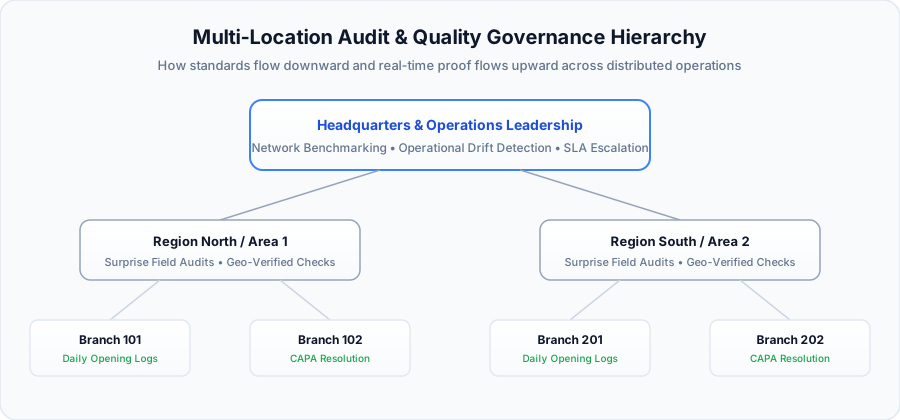
Multi-Location Audit Management is the centralized process of planning, assigning, executing, tracking, and improving quality and compliance inspections across distributed branch networks. The goal is not just to collect inspection forms, but to keep standards, scoring algorithms, evidence rules, and corrective actions synchronized across the entire network.
For a foundational introduction to audit management, see What Is Audit Management? A Plain-English Guide. This guide focuses specifically on the additional challenges that arise when the business operates across multiple locations simultaneously.
Why Audit Management Breaks as Businesses Scale
At a small scale, direct oversight compensates for weak audit systems. Once the network expands beyond what one person can personally monitor, the weaknesses become visible: template drift, invisible completion status, weak corrective follow-up, and untrustworthy results.
Each of those failure modes compounds the others. Template drift makes cross-location comparison meaningless. No real-time status means missed audits stay hidden. Weak follow-up means the same failures keep appearing. Unverifiable results mean the business is making decisions based on data it cannot trust.
The Four Failure Modes of Multi-Location Audits
Multi-location audit programmes fail in predictable ways. Knowing the four failure modes makes it possible to design a system that prevents each of them rather than reacting after the damage is done.
1. Template Drift
Without a central blueprint, managers adjust checklists over time and results stop being comparable across branches. A score of 80 at Branch A and 80 at Branch B means nothing if the questions and severity weights were different.
2. No Real-Time Status
If audits are managed through chat or spreadsheets, the admin cannot reliably tell which audits are published, assigned, in progress, completed, or missed. Problems stay invisible until someone manually discovers them. See audit tracking software for more on what real-time visibility requires.
3. Follow-Up Collapse
Even when branches are audited, failed items often stay inside the report and never become corrective actions with deadlines. The finding is recorded but not resolved. See how to track corrective actions across multiple locations for how the follow-up system closes that gap.
4. Unverifiable Submissions
If the system does not require evidence or record physical presence, the score may represent what was typed rather than what was found on the ground. Unverifiable audits erode the value of the entire audit programme.
What a Good Multi-Location Audit System Needs
A multi-location audit system needs to address all four failure modes simultaneously – standardised blueprints, real-time status, automated corrective actions, and verified submissions. Addressing only some of them leaves the others to undermine the programme.
| Capability | Why It Matters |
|---|---|
| Standardised Blueprints | Keeps questions, severity, and evidence rules identical across all locations |
| Node-Based Location Structure | Lets each location be managed and reviewed separately inside one organisation |
| Role-Based Routing | Keeps responsibilities clear between admin, manager, and auditor |
| Real-Time Audit Status | Shows what is active, assigned, in progress, completed, or missed |
| Auto-CAPA | Turns failed critical items into tracked actions with deadlines and proof requirements |
| Cross-Branch Comparison | Identifies consistently weak and strong locations across the network |
| Trend Alerts | Surfaces repeated poor performance before it becomes a larger operational problem |
How Audiment Handles Multi-Location Audit Management
Audiment's workflow is built around a strict three-tier structure isolated by organisation. Admins create blueprints, define nodes, publish audits, and review results across all locations. Managers oversee assigned locations. Auditors execute field audits through a mobile-optimised interface.
The standard lifecycle runs: admin creates a blueprint → defines a location node → publishes the audit with a deadline → manager assigns it to an auditor → auditor completes it with evidence → system geo-tags and scores the submission → critical failures automatically generate corrective actions with a 48-hour SLA.
Why Scoring Consistency Matters Across Locations
One reason multi-location audit programmes fail is that businesses compare scores that were not generated under the same logic. A centralised scoring model ensures that the same question, the same severity weight, and the same evidence rule applies at every location – making cross-location comparison credible.
Audiment uses one centralised scoring model: yes/no answers normalise to 1.0 or 0.0, rating questions normalise as rating divided by 10, and severity weights are fixed at Low = 1, Medium = 2, Critical = 5. A critical failure can override the grade with criticalfail regardless of the overall percentage. For more detail on how scoring works, see what is an audit score.
Common Mistakes in Multi-Location Audit Programmes
The most common mistakes are letting each region customise templates, relying only on scheduled audits, failing to enforce photo proof, and treating corrective actions as separate admin work rather than part of the audit lifecycle.
Another mistake is focusing only on average scores instead of looking at trend data, missed audits, and repeated failures over time. A location that scores 78 consistently is different from one that has been declining from 90 to 78 across four audits – and the system should surface that distinction automatically.
A Practical Example
A retail chain with 42 stores publishes the same weekly store standards blueprint to all nodes every Monday, with photo requirements enabled for merchandising, safety, and cleanliness questions.
Managers assign those audits to local auditors, and the admin dashboard shows active audits in flight, open corrective actions, compliance score, and ranked cross-branch performance. If Store 18 keeps scoring below threshold three audits in a row, the system sends a priority trend alert – because the problem is now structural, not incidental.
Frequently Asked Questions
What is multi-location audit management?
Multi-location audit management is the process of running, tracking, and improving audits across many branches from one system – with consistent templates, scoring rules, proof requirements, and corrective workflows applied across every location simultaneously.
How do you manage audits across multiple locations?
Use standardised blueprints, assign clear ownership by role, capture evidence during execution, automate corrective actions for serious failures, and review trends across all locations from one dashboard. The key is making the entire workflow system-managed rather than person-managed.
What is the biggest challenge in distributed audit management?
The biggest challenge is keeping results trustworthy at scale. Once the business can no longer rely on personal visits, proof, tracking, and consistency become more important than the checklist itself. A system that does not verify evidence or enforce follow-up creates a false sense of compliance.
Does Audiment support multi-location audit management?
Yes. Audiment supports blueprints, nodes, role-based access, active audit monitoring, cross-branch comparison, auto-CAPA, trend alerts, and PDF export across a single organisation – all built around a centralised scoring model that makes cross-location comparison credible.
What is template drift and how do you prevent it?
Template drift happens when different locations use different versions of the same checklist, making results incomparable. It is prevented by centralising blueprint management so that every location receives the same questions, severity weights, and evidence rules from the admin – with no ability for individual locations to modify the template.
Related reading:
- What Is Audit Management? A Plain-English Guide for Multi-Location Businesses
- Audit tracking software: how to monitor audit progress across locations
- Best Audit Management Software in 2026: Compared for Multi-Location Teams
- What is an audit score? How scoring works in multi-location audits
See how Audiment handles audit management across multi-location businesses. Book a call with Audiment.
Ready to digitize your audit process?
See how multi-location teams use proof-based audits and corrective actions to stay on top of quality and compliance.